UAE vehicle priority rules 2026: six categories and six yielding situations
UAE vehicle priority covers six legal categories, not every service van. Learn the six yielding situations and how to make room safely.
- 9 min read
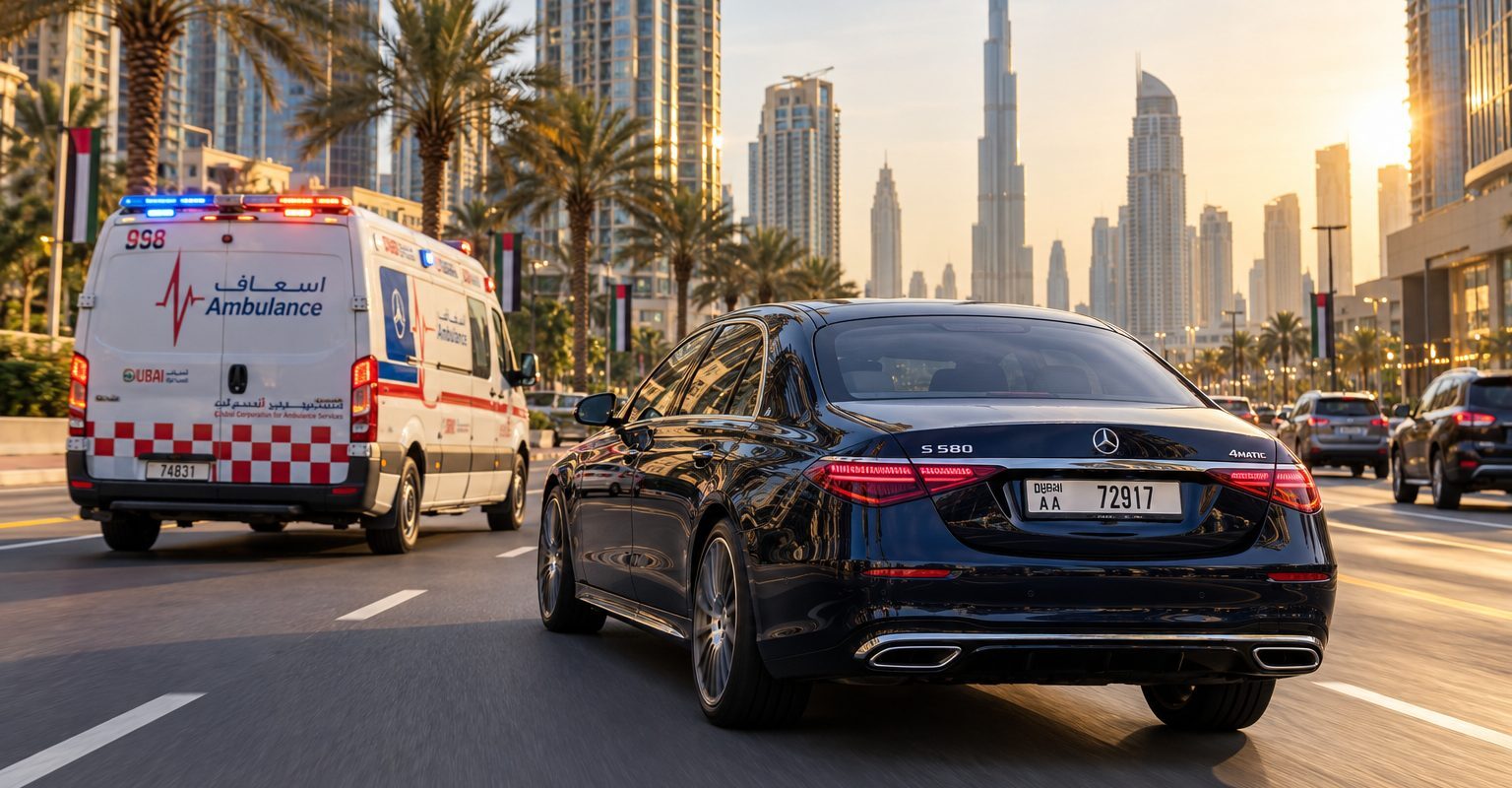
UAE vehicle priority rules distinguish six legal vehicle categories from six practical yielding situations published by Abu Dhabi Police. Ordinary service vans do not automatically have priority. When an emergency vehicle approaches, make space safely, keep the hard shoulder clear, and never assume its permission to cross a red light extends to you.
Key facts
- As of March 2025, Article 6 identifies six priority categories in Federal Decree-Law No. 14 of 2024, Regulating Traffic.
- As of March 2025, the new traffic law took effect on 29 March 2025, according to the UAE Government road-safety guidance.
- As of May 2025, six practical yielding situations appear in the Abu Dhabi Police General Headquarters campaign announcement.
Which vehicles have UAE vehicle priority?
UAE traffic law gives priority to specified categories, including emergency vehicles and certain essential-service vehicles. However, the conditions attached to each category matter: a commercial vehicle does not gain priority simply because it provides a service.
The legal categories below come from the traffic law identified in Key facts. They are different from the practical road situations in the Abu Dhabi Police campaign.
| Legal category | Condition or distinction |
|---|---|
| Official processions | The category concerns official processions, not an ordinary group of vehicles. |
| Civil-defence vehicles | Priority applies while they are on duty. |
| Vehicles transporting patients and wounded people | Priority applies while performing their duties. |
| Military vehicles | The law specifies vehicles moving in convoys. |
| Police vehicles | The law specifies vehicles using warning sounds and lights. |
| Vehicles providing essential services | The services must be specified by a ministerial resolution. |
Therefore, assess the vehicle and the circumstances rather than relying on its branding. A company logo, recovery body or maintenance equipment alone does not establish legal priority.
What are the six emergency vehicle yielding situations?
Abu Dhabi Police guidance covers main roads, traffic jams, internal roads, intersections, roundabouts and narrow dual-lane roads. These emergency vehicle yielding rules explain how to create space; they are not an additional list of vehicle categories.
The following table summarises the campaign guidance identified in Key facts. In every situation, check the space around your vehicle before changing position.
| Situation | Abu Dhabi Police guidance | Key caution |
|---|---|---|
| Main road | Move right when an emergency vehicle approaches from behind. | Change lanes only when safe. |
| Traffic jam | Keep the hard shoulder clear. | Do not use it to bypass congestion. |
| Internal road | Make space to the right or left where safe. | Avoid abrupt or dangerous movements. |
| Intersection | Stop and wait on a side road, including when your signal is green, to let the emergency vehicle pass. | Do not follow it through a red light. |
| Roundabout | Do not enter when an emergency vehicle approaches. If already inside, continue and move right when safe. | Do not stop suddenly inside the roundabout. |
| Narrow dual-lane road | Move as far right as safely possible without using the shoulder. Opposing traffic should also make room. | Keep the emergency vehicle’s route clear. |
What should you do when an emergency vehicle approaches?
Notice the warning, assess surrounding traffic and create space predictably. Giving way to an ambulance should not involve a sudden swerve or a manoeuvre that endangers another driver.
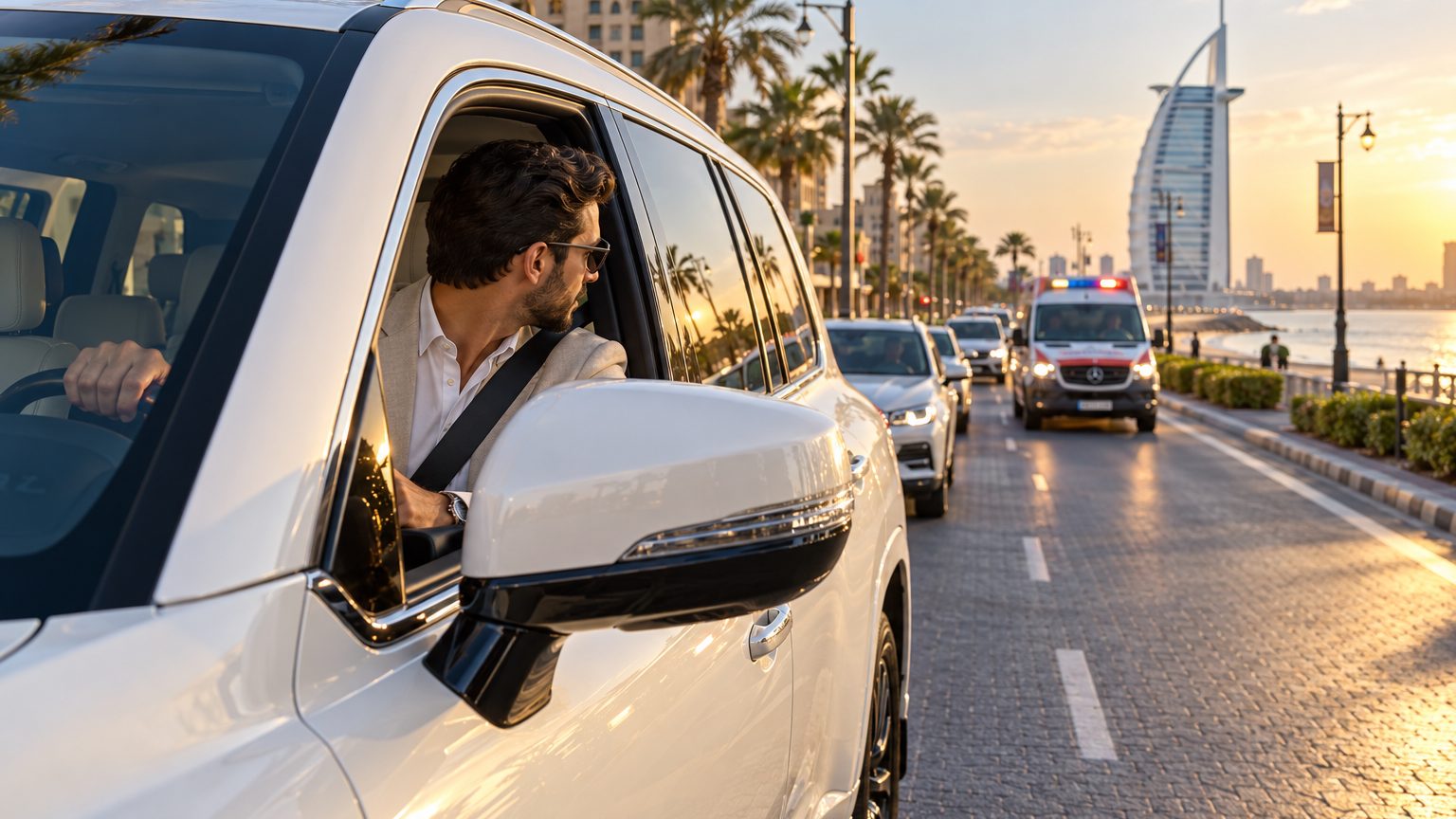
- Identify the direction of the siren or warning lights.
- Check your mirrors and the traffic beside your vehicle.
- Move safely into available space appropriate to the road situation.
- Keep the hard shoulder clear.
- Stop or wait where the situation requires it.
- Continue according to your own signals and road conditions after the emergency vehicle passes.
In congestion, space may open gradually rather than immediately. Therefore, make a controlled adjustment instead of forcing your vehicle between occupied lanes.
Also, avoid copying another driver’s movement without checking your own surroundings. Their available space may be different from yours.
Should you use the hard shoulder or stop inside a roundabout?
Abu Dhabi Police guidance says to keep the hard shoulder clear and avoid stopping suddenly inside a roundabout. Instead, use the safe movement appropriate to your position.
On a main road, move right when it is safe. However, that instruction does not turn the hard shoulder into an overtaking lane or a route around a queue.
At a roundabout entrance, wait if an emergency vehicle is approaching. If you are already circulating, continue and move right when safe rather than braking abruptly in its path.
Similarly, on a narrow road, create space without driving onto the shoulder. The aim is a clear route, not a new obstruction.
Can you move through a red light to make way?
An emergency vehicle’s authority to cross a red light does not give ordinary drivers blanket permission to follow it. Make room cautiously, but do not assume you may drive into conflicting traffic.
Abu Dhabi Police campaign guidance explains that emergency vehicles may cross on red, generally after pausing. Meanwhile, drivers approaching from a side road should stop and wait, even when their signal is green.
If you are waiting at red, assess pedestrians, nearby vehicles and the available space before making any adjustment. A limited movement to create room is not the same as permission to proceed through the junction.
When a police officer directs traffic, follow the officer’s instructions. Otherwise, do not improvise a dangerous crossing simply because you hear a siren.
Do recovery trucks and service vans always have priority?
No. UAE service vehicle right of way depends on the legal category and applicable conditions, not simply the work a vehicle performs.
The law includes essential-service vehicles specified by a ministerial resolution. However, the research available for this article does not establish a verified official list of every qualifying service or its operating conditions.
Therefore, do not treat every recovery truck, maintenance van or delivery vehicle as an emergency vehicle. Equally, leave safe space around vehicles attending an incident without assuming their presence removes your normal driving obligations.
What is the fine for not giving way?
Avoid treating one published penalty as a confirmed, uniform figure across every emirate. Official materials differ, so attribution and the source date matter.
As of May 2025, the Abu Dhabi Police campaign announcement stated AED 3,000, 30 days of vehicle impoundment and 6 traffic points for failing to give priority to the emergency and official vehicles it identified.
However, other official-hosted penalty materials show a different monetary amount and do not present the same impoundment consequence. These should not be silently combined into one penalty.
Rules change. Before relying on a penalty amount, check with the relevant emirate’s police authority or the Ministry of Interior (MOI). The practical obligation remains to make way safely.
Where can UAE Parking help after your journey?
UAE Parking helps with parking-message preparation, not emergency-vehicle manoeuvres. It is independent and is not affiliated with police or transport authorities.
For example, the Dubai parking page builds the parking SMS in your browser and lists zone rates and operating hours. The free iPhone and Android app also lets you save plates on your device.
If you then use street parking, the sign next to the bay is the final word on parking conditions.
For the separate eligibility question, read our guide to the reported speed exemption for doctors and essential-service drivers, including what still needs official confirmation.
When approaching an accident, keep emergency access clear and understand how the UAE rubbernecking fine differs from slowing for a genuine hazard.
Frequently asked questions
Are the six vehicle categories the same as the six yielding situations?
No. The traffic law identifies categories of priority vehicles, while Abu Dhabi Police guidance describes practical road situations. A road situation does not create a new category of priority vehicle.
Does every service van have right of way in the UAE?
No. Essential-service priority depends on the legal provisions and services specified by ministerial resolution. Commercial branding alone does not establish priority.
Should I use the hard shoulder to let an ambulance pass?
Abu Dhabi Police guidance says to keep the hard shoulder clear. Instead, create space safely within the road situation without using the shoulder to bypass traffic.
Can I follow an emergency vehicle through a red light?
No. An emergency vehicle’s permission to cross a red light does not extend to ordinary drivers. Follow your own signals and avoid entering conflicting traffic.
Bottom line
Separate the legal vehicle categories from the practical yielding situations. Then make space calmly, keep the shoulder clear and avoid unsafe movements at junctions. For parking-message preparation after your journey, download the free UAE Parking app for iPhone or Android.