UAE traffic rules 2027: motorists, delivery riders and scooters
UAE traffic rules change from January 2027 for motorists, delivery riders and scooter riders. Check confirmed duties and unresolved details.
- 9 min read
UAE traffic rules introduce a driving-hours limit, delivery-driver duties and a personal-mobility permit framework from 1 January 2027, as of November 2026, according to the Emirates News Agency (WAM) announcement. Motorists should plan for fatigue, delivery riders should check work equipment and permits, and scooter riders should verify local requirements before riding.
Key facts
- As of November 2026, WAM reports a maximum of 9 driving hours in any 24-hour period, with detailed implementation guidance still needed.
- As of November 2026, the announced federal personal-mobility permit framework sets a minimum applicant age of 15 and validity of 3 years.
- As of July 2026, the Roads and Transport Authority (RTA) scooter permit service lists eligibility from age 16 in Dubai. Do not assume the federal announcement changes that local rule.
What do UAE traffic rules change for each group?
The announced federal requirements cover motorists, delivery drivers and personal-mobility riders differently. However, existing emirate-specific requirements remain important, especially for Dubai delivery motorcycles and scooters.
WAM summarises the implementing regulations rather than providing the complete decision text in the reviewed English announcement. Therefore, distinguish the announced duties from operational details that authorities still need to clarify.
| Road-user group | Announced requirement | Timing and source | Still unclear |
|---|---|---|---|
| Motorists | Maximum 9 driving hours per 24 hours; no driving while dangerously fatigued | From 1 January 2027, as of November 2026: WAM federal announcement | Detailed scope, recording, rest intervals and a separate penalty |
| Delivery drivers | Professional permit, prescribed uniform and approved vehicle systems; motorcycle delivery restrictions on passengers and backpacks | From 1 January 2027, as of November 2026: WAM delivery requirements | Specific federal penalties and local implementation details |
| Personal-mobility riders | Permit framework, designated routes and technical requirements | From 1 January 2027, as of November 2026: WAM mobility provisions | How Dubai will reconcile its published scooter age requirement |
Does the UAE nine-hour driving limit apply to private motorists?
The official announcement uses the broad term “drivers”, but detailed application to private and professional driving remains unclear. You should not assume either a private-driver exemption or a confirmed monitoring system.
As of November 2026, WAM describes a maximum of 9 hours in any 24-hour period, subject to adjustment by the Federal Traffic Council. It also prohibits driving when fatigue or exhaustion compromises safety.
However, the reviewed announcement does not explain compulsory rest intervals, how authorities will record driving time, or a distinct penalty. For now, plan journeys conservatively and stop when fatigue affects your ability to drive safely.
What new rules apply to UAE delivery riders in 2027?
Delivery drivers must wear the prescribed uniform, carry a valid professional permit and use approved systems installed in their vehicles. Motorcycle delivery riders must also use designated, approved equipment for carrying orders.
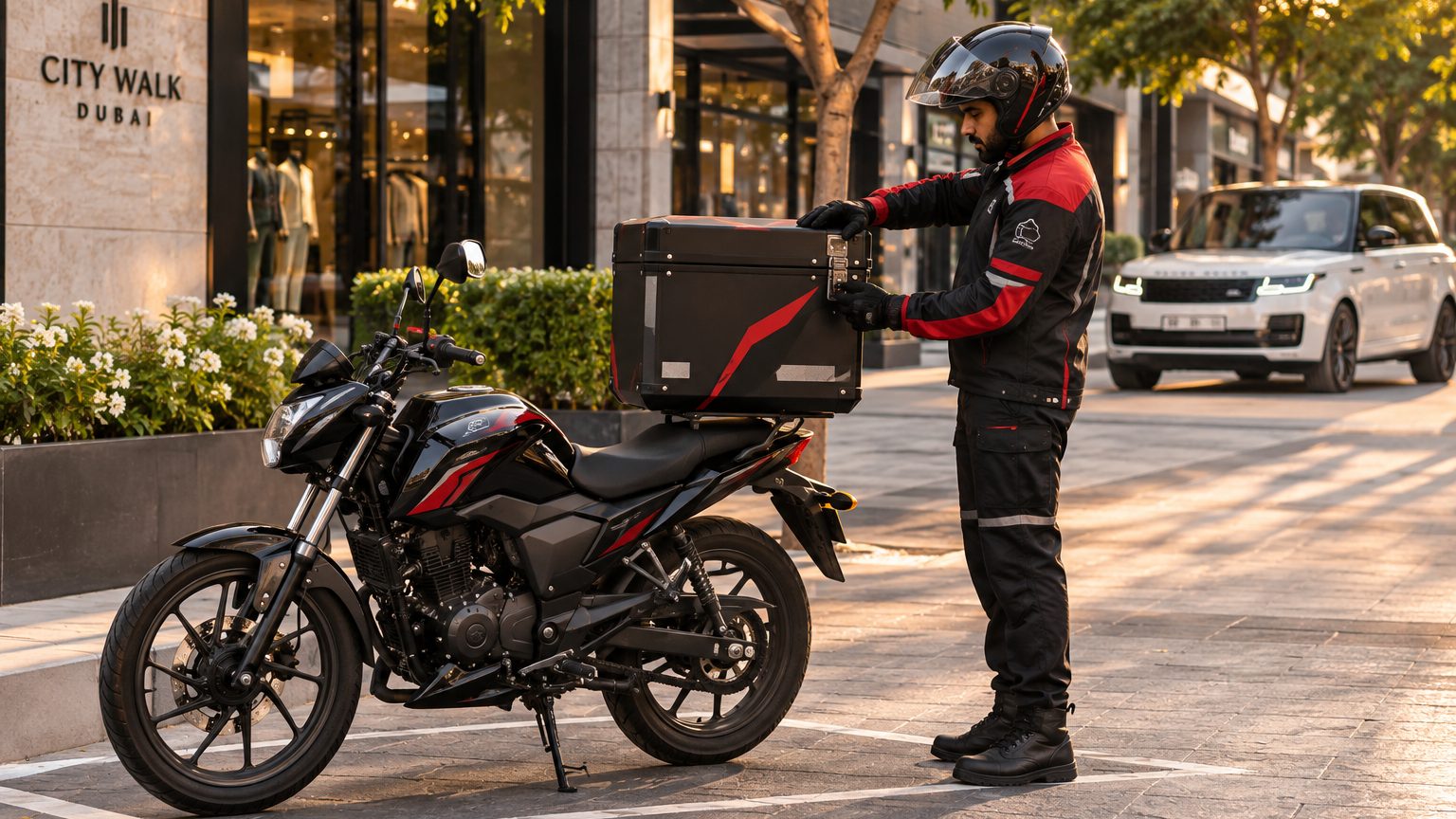
The UAE delivery rider rules 2027 take effect on 1 January 2027, as of November 2026, according to WAM’s federal announcement. Riders must present their professional permit when requested.
During deliveries, motorcycle riders may not carry a passenger or use a backpack for orders. Instead, check the approved carrying equipment with your employer or licensing authority; do not assume an ordinary bag or box qualifies.
What is the Dubai delivery-bike lane rule?
Dubai already restricts delivery motorcycles from specified leftmost lanes. These restrictions are separate from the forthcoming federal delivery duties.
As of October 2025, WAM’s RTA announcement set the following rules from 1 November 2025.
| Road layout | Delivery-motorcycle restriction | Dated source |
|---|---|---|
| 5 or more lanes | Do not use the 2 leftmost lanes | As of October 2025: WAM lane announcement |
| 3 or 4 lanes | Do not use the leftmost lane | As of October 2025: WAM lane announcement |
| 2 lanes or fewer | No lane restriction under this announced rule | As of October 2025: WAM lane announcement |
As of October 2025, the published lane-rule penalties are AED 500 for a first offence, AED 700 for a second, and permit suspension for a third. These are not penalties for the new federal backpack or passenger restrictions.
How is Dubai’s monitoring programme different?
Dubai’s monitoring programme covers devices, motorcycle cameras and platform connectivity. It is not evidence that every emirate requires the same equipment.
As of November 2026, WAM’s RTA monitoring announcement says installation and connection remain optional through 30 June 2027, with mandatory implementation following that transition period. Operators should check the technical arrangements directly with RTA.
What is the minimum age for an e-scooter permit?
The federal announcement sets a minimum permit applicant age, but Dubai’s published eligibility remains different. Consequently, younger riders should not treat the federal announcement as permission to ride in Dubai.
As of November 2026, WAM reports a minimum applicant age of 15 and permit validity of 3 years under the framework taking effect on 1 January 2027. The permit provisions cover electric bicycles, electric scooters and small-wheeled cycles.
However, as of July 2026, RTA’s Dubai permit service lists eligibility from age 16. The reviewed sources do not explain how Dubai will reconcile the requirements. Rules change, so check RTA’s current guidance before riding.
Which routes and safety equipment do scooter riders need?
Personal-mobility riders must use routes or roads designated by the relevant licensing or traffic-control authority. A permit does not authorise riding on every road or pavement.
The announced technical requirements include a front light, a rear position light with a red brake light, a handlebar-mounted audible warning device and a rear-wheel brake. Keep tyres and other components safe and maintained.
Additionally, local authorities may impose further requirements. Check the rules for your emirate rather than relying on a permit or equipment checklist from somewhere else.
What should you do before the changes take effect?
Check the requirements for your activity and emirate before changing how you drive, deliver or ride. In particular, do not rely on unconfirmed claims about exemptions or enforcement technology.
- Identify whether you are driving privately, delivering professionally, operating a delivery business or riding a personal-mobility device.
- Check your professional permit with your employer or licensing authority.
- Confirm the prescribed delivery uniform and approved order-carrying equipment.
- Review Dubai’s existing delivery-motorcycle lane restrictions if you work there.
- Verify your scooter permit eligibility and permitted route with the relevant local authority.
- Plan driving around fatigue without assuming an unannounced logging system or compulsory break schedule.
- Recheck official implementation guidance close to commencement.
Where can UAE Parking help?
UAE Parking helps with a separate task: preparing the parking SMS when you park. It does not establish traffic-law compliance or replace guidance from the relevant authority.
The independent, free app is available for iPhone and Android. Its Dubai parking page also builds the message in your browser. When choosing a bay, the sign next to it is the final word.
For the delivery-specific requirements, read our guide to UAE delivery rider rules on backpacks and passengers, including approved equipment and the delivery-duty passenger restriction.
Drivers travelling with children should check child front-seat eligibility and restraint requirements separately before setting off.
Delivery operators should also review Dubai’s delivery motorcycle monitoring system, including the optional transition and the technical details still awaiting clarification.
Our guide to taxi passenger rights under the reported UAE rules explains unjustified refusal, approved fares and why local penalties should not be treated as nationwide fines.
Frequently asked questions
Can delivery riders carry passengers or use backpacks for orders?
The announced federal rules prohibit motorcycle delivery riders from carrying passengers while delivering or using backpacks to carry orders. Riders must use designated, approved carrying equipment.
Does the driving-hours announcement confirm a monitoring app?
No. The reviewed federal announcement does not specify a mandatory app, logbook, recording method or compulsory rest schedule. Drivers should still avoid driving when fatigue affects safety.
Will Dubai automatically adopt the lower federal scooter permit age?
The reviewed sources do not confirm that Dubai will automatically change its published eligibility requirement. Check RTA’s current local guidance before riding.
Are fines confirmed for the new federal delivery restrictions?
The reviewed announcement does not state specific federal fines for the backpack ban or delivery-passenger ban. Dubai’s existing delivery-motorcycle lane penalties are separate.
Bottom line
Prepare for the announced federal duties, but keep local rules separate. Motorists need clarity on driving-hours implementation; delivery riders need approved work arrangements; scooter riders need the correct permit, route and equipment. For the separate task of preparing a parking message, you can download the free UAE Parking SMS helper.